
Introduction
One of the most important ideas in long-term investing is compounding.
The basic idea is simple: when an investment grows, those gains can remain invested and potentially contribute to future growth as well. Over long periods, this can make a meaningful difference to the value of your investments.
Compounding does not make investing risk-free, and it does not guarantee that an investment will grow every year. Market-linked investments can rise and fall. But when returns remain invested and growth compounds over time, the effect can become increasingly significant.
That is why time is such an important part of long-term investing.
What is compounding?
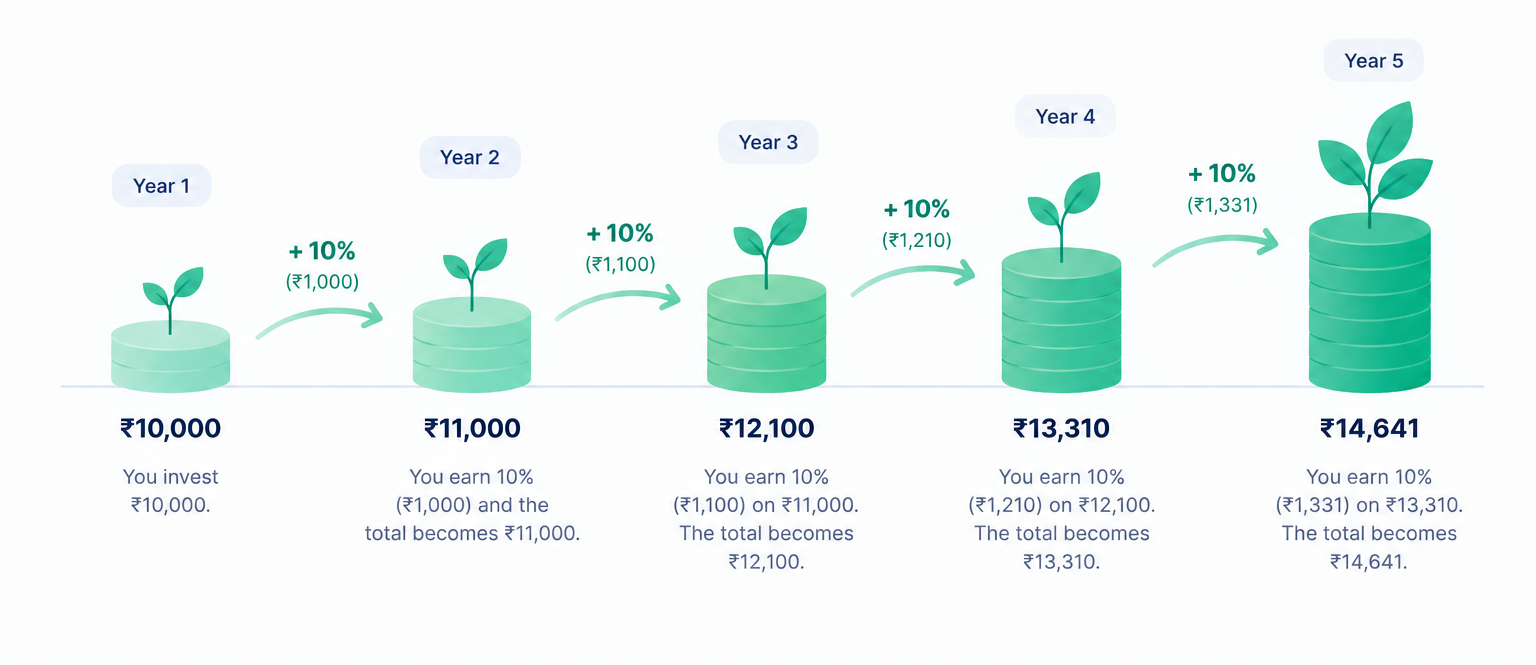
Compounding happens when growth on an investment becomes part of the amount that can potentially grow in the future.
Imagine you invest ₹10,000 and it grows by 10%.
After the first period, your investment would be worth:
₹11,000
The ₹1,000 gain remains invested. If the investment grows by another 10%, the next calculation is based on ₹11,000 rather than the original ₹10,000.
That would make the value:
₹12,100
The additional ₹100 comes from growth on the earlier ₹1,000 gain.
This is the basic idea behind compounding: growth can itself become part of the amount that participates in future growth.
For investments where returns fluctuate, the actual path will not look this smooth. The example is simply a way to understand the underlying concept.
Simple growth vs compounding
It helps to compare compounding with a situation where growth is calculated only on the original amount.
Suppose ₹10,000 grows at an assumed 10% rate.
With simple growth, if you added ₹1,000 every year based only on the original ₹10,000, the value after five years would be:
₹15,000
With annual compounding at the same assumed rate, the value would be approximately:
₹16,105
The difference is created because each year's growth remains invested and can participate in subsequent growth.
This difference becomes much more noticeable over longer periods.
Why does time matter so much?
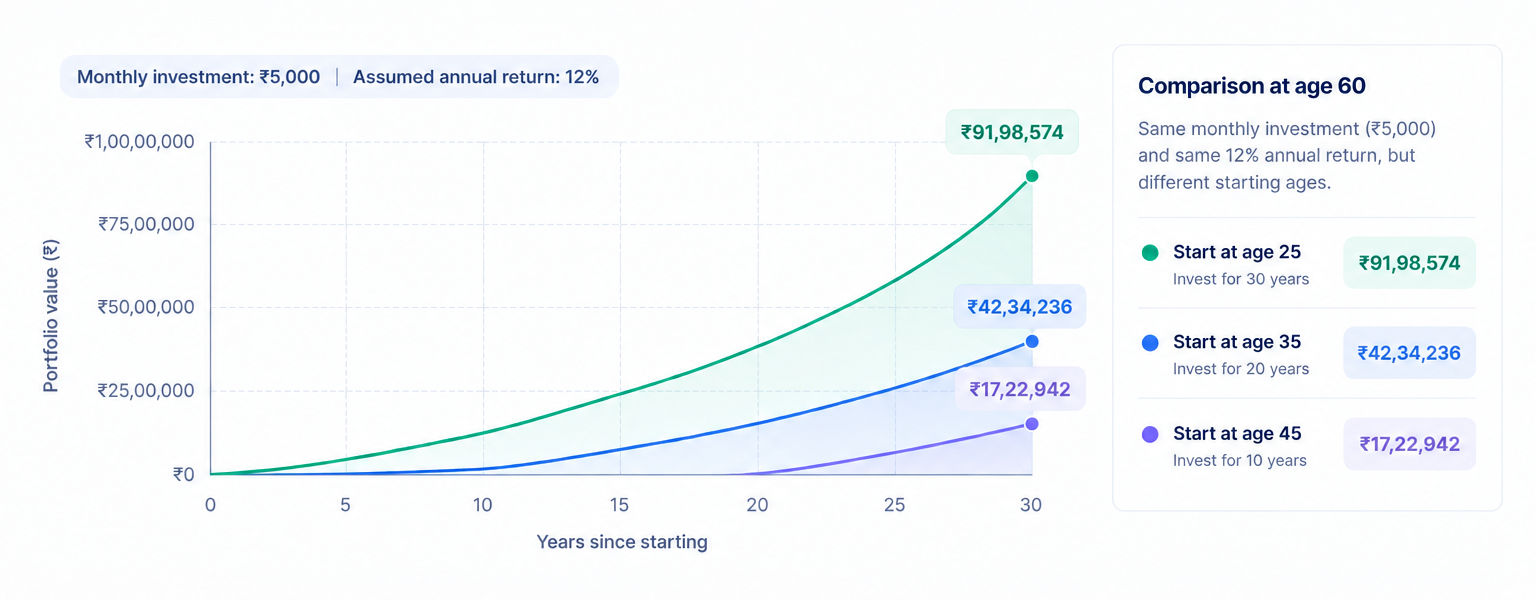
Compounding needs time to work.
In the early years, the amount of growth may appear relatively small. As the investment value becomes larger, the same percentage rate can represent a larger amount of growth.
Consider the difference between:
- Investing for 5 years
- Investing for 10 years
- Investing for 20 years
The additional years are not simply adding another equal period of growth. Earlier growth remains invested and can itself contribute to later growth.
This is one reason long-term investing is often discussed together with compounding.
Starting earlier changes the equation
Suppose two people eventually want to build wealth for a long-term goal.
One starts investing earlier and has more years for the investment to potentially grow. The other starts later and has fewer years.
Even if both invest regularly, the person who starts earlier has given their contributions more time to remain invested.
Starting earlier does not guarantee a better investment outcome. Actual returns, contributions, fees, taxes, and market conditions all matter. But time in the market can be an important variable in a long-term plan.
A simple compounding example
Let's look at a hypothetical example.
Suppose you invest:
- ₹5,000 every month
- For 20 years
- At an assumed annual return of 10%
Over 20 years, your total contributions would be:
₹12,00,000
Using a monthly compounding illustration, the estimated value would be approximately:
₹38,00,000
That means approximately:
₹26,00,000
of the final value would represent estimated growth rather than your original contributions.
The important point is not the exact final number. It is the relationship between regular contributions, time, and assumed growth.
Illustration: This example uses a constant assumed return for simplicity. Real investments do not normally deliver the same return every month or every year, and actual results can be higher or lower.
Your contributions are only part of the story
When you look at the future value of a long-term investment, it is useful to separate two things:
What you put in
and
What your investment growth adds over time
For example:
Total future value
        │
        ├── Your contributions
        │
        └── Investment growth
As the investment period becomes longer, the growth portion can become a larger part of the total value under a positive-return scenario.
This is why a long-term investment projection can sometimes look very different from simply adding up your monthly contributions.
Compounding and regular investing
Compounding and regular investing are related, but they are not the same thing.
A Systematic Investment Plan (SIP) is a method of investing a fixed amount at regular intervals, commonly into mutual funds.
Compounding describes what can happen when investment growth remains invested and can contribute to future growth.
You can therefore think of them as two different ideas:
Regular investing
        │
        ▼
Repeated contributions
        │
        ▼
Money remains invested
        │
        ▼
Potential investment growth
        │
        ▼
Growth can contribute to future growth
An SIP does not guarantee compounding returns, and it does not guarantee that an investment will increase in value.
The underlying investment still carries market risk.
Why compounding can be powerful over long periods
There are three ideas worth remembering:
1. Growth can build on previous growth
When gains remain invested, future growth can apply to a larger investment value.
2. Time gives growth more opportunity
The longer an investment remains invested, the more periods there are in which growth can potentially accumulate.
3. Regular contributions add to the base
With an SIP or another regular investment approach, new contributions continue to add to the amount that is invested.
Together, these factors can make long-term investing very different from simply saving the same amount of money without investment growth.
What can reduce the effect of compounding?
Compounding is not a guaranteed upward curve.
Several factors can affect the actual outcome.
Investment returns
The assumed return used in a calculator is only an assumption. Actual market-linked returns vary over time.
Fees and expenses
Investment products can have costs that reduce the amount available to compound.
Taxes
Depending on the investment and the applicable tax rules, taxes can affect the amount you ultimately keep.
Withdrawals
Taking money out reduces the amount that remains invested and therefore reduces the base available for future growth.
Inflation
Even if the nominal value of an investment grows, inflation can reduce what that money can buy in the future.
This is why looking only at a future rupee amount can sometimes give an incomplete picture.
Compounding does not mean guaranteed returns
This is an important distinction.
A compounding illustration often assumes something like:
"10% annual return for 20 years."
That does not mean an investment will actually return 10% every year.
A market-linked investment could have:
- A positive year
- A negative year
- A year with little or no growth
- Several years with very different returns
A calculator uses a constant assumption to make the mathematics easier to understand.
The resulting number is therefore an estimate, not a promise.
Past investment performance also does not guarantee future returns.
Compounding and inflation
There are two different questions to consider when thinking about long-term wealth:
- How much could the investment grow to?
- What could that amount be worth in today's purchasing power?
Suppose an investment grows from ₹10 lakh to ₹20 lakh over a long period.
At first glance, ₹20 lakh sounds like twice the original amount.
But if prices also rise during that period, ₹20 lakh in the future may not buy twice as much as ₹10 lakh buys today.
This is why long-term planning should consider both investment growth and inflation.
You can explore this relationship using the SIP Calculator, which includes an inflation assumption alongside investment return and duration.
The difference between rate and time
When people talk about compounding, they often focus on the return assumption.
But time matters too.
Consider two hypothetical investments with the same assumed annual return:
- Investment A remains invested for 10 years.
- Investment B remains invested for 20 years.
The second investment has twice as many years for the growth process to continue, but its final value will not simply be twice the first investment's value.
That is because earlier growth remains part of the investment and can itself participate in later growth.
This is one of the defining characteristics of compound growth.
Does a higher return always mean a better outcome?
Mathematically, a higher assumed return produces a higher projected future value when all other inputs remain the same.
But real investing is not a spreadsheet exercise.
Higher-return opportunities can also involve higher levels of risk or uncertainty. A return assumption should therefore be treated as an assumption, not as a target that an investment is guaranteed to achieve.
When using a calculator, it can be useful to compare several assumptions rather than focusing on a single number.
For example:
Lower assumption
      │
      ├── Base assumption
      │
      └── Higher assumption
Seeing a range can help demonstrate how sensitive a long-term projection is to the return assumption.
Compounding and your financial goals
Compounding becomes more meaningful when connected to a specific goal.
Instead of asking:
"How much money can I make?"
you can ask:
"How much might I need, and how much time do I have?"
For example, you might be planning for:
- A child's education
- A home purchase
- Retirement
- Financial independence
- Another long-term financial goal
The goal determines the time horizon. The time horizon influences how much opportunity there is for investment growth to compound.
This is why financial planning should generally begin with the goal rather than with a particular return assumption.
A useful way to think about compounding
You do not need to remember a complicated formula.
Think of compounding as a cycle:
Money invested
      ↓
Investment growth
      ↓
Growth remains invested
      ↓
Larger amount participates in future growth
      ↓
Potentially more growth
      ↓
Repeat over time
The cycle is simple.
The challenge is giving it enough time while understanding that actual investment returns are uncertain.
Using a calculator to understand compounding
A calculator can help you see how different assumptions affect a long-term projection.
Try changing:
- Monthly investment
- Investment duration
- Expected annual return
- Inflation
For example, keep the monthly investment constant and change only the investment duration.
Then compare the estimated future values.
You can also keep the duration constant and change the assumed return.
This makes it easier to see how sensitive long-term projections can be to both time and return assumptions.
Key takeaways
- Compounding means growth can remain invested and participate in future growth.
- Time is an important part of compound growth.
- Regular contributions can increase the amount that remains invested over time.
- SIP and compounding are related concepts, but an SIP is an investment method while compounding describes how growth can accumulate.
- Actual investment returns are not guaranteed and will fluctuate for market-linked investments.
- Fees, taxes, withdrawals, and inflation can affect the outcome.
- Calculator projections are illustrations based on assumptions, not promises of future returns.
- Connecting investments to a financial goal can make long-term planning more meaningful.
A final thought
Compounding is powerful because it gives growth the opportunity to build on previous growth.
But there is no shortcut hidden inside the concept.
The result still depends on how much you invest, how long you stay invested, what returns the investment actually produces, and the costs and taxes that apply.
For long-term investing, the most useful question is therefore not simply:
"What return can I get?"
It is also:
"How much time do I have, what am I investing for, and what assumptions am I making?"
Those questions can help turn a simple compounding calculation into a more useful part of a financial plan.
Educational disclaimer: This article is for educational purposes only and does not constitute financial advice. Investment values and returns can fluctuate, and past performance does not guarantee future results. Consider your goals, risk tolerance, time horizon, and the relevant product information before making investment decisions.